Science at the Cervantes Institute in Berlin
On 25 March 2026, I moderated a bilingual Spanish–German conversation at the Instituto Cervantes Berlin about PLATO, the European Space Agency’s (ESA) mission designed to search for and characterize rocky planets around Sun-like stars.
The panelists were:
- Prof. Heike Rauer, Joint Professor at Freie Universität Berlin and German Aerospace Centre (DLR), Advisor on ESA matters as well as Head of the PLATO Mission Consortium and
- Prof. José Miguel Mas-Hesse, Head of the Astrophysics Department at Centro de Astrobiología (CSIC-INTA) and also board member of the PLATO mission consortium.
This event is part of CERFA’s close collaboration with the Instituto Cervantes Berlin in its Science Program.
We began with the instrument itself (its actual hardware components) and then moved toward the more difficult, speculative questions like:
- What can a planet’s mass, radius and age really tell us about its habitability?
- Where does astronomical measurement end and astrobiological inference begin?
Framing this fundamental discussion was a different, more down-to-earh question:
- What kind of scientific culture and administrative gymnastics are required to coordinate nearly two thousand people across 26 countries for a mission with one launch and no second attempt?
See for yourself below!
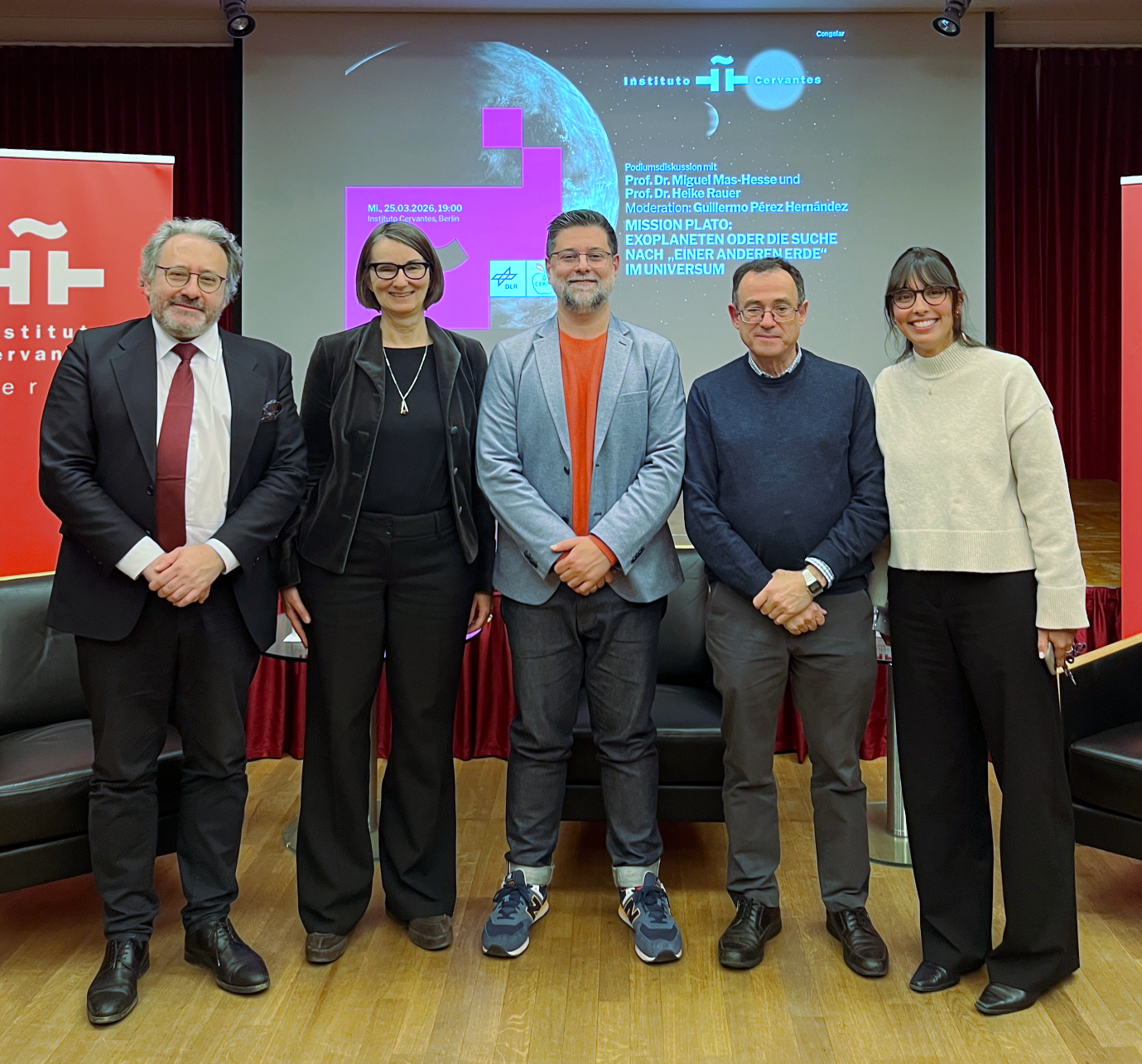 From left: Ignacio Martínez-Castignani (Instituto Cervantes), Heike Rauer, Guillermo Pérez-Hernández, José Miguel Mas-Hesse and Marina Cano Amoros (DLR).